MQTT Client for Mac
TestMQTT for macOS: a free desktop MQTT client for Apple Silicon and Intel Macs. Connect, subscribe, publish and inspect payloads — over TCP, TLS or WebSockets.
Version 1.0.0 ·
Download TestMQTT for macOS
System requirements: macOS 12 Monterey or later
How to install TestMQTT on macOS
- Download the .dmg for your Mac: Apple Silicon for M1 and newer, Intel for older Macs.
- Open the .dmg and drag TestMQTT into the Applications folder.
- First launch: macOS says it cannot verify TestMQTT. Click Done, then open System Settings → Privacy & Security, scroll down and click “Open Anyway”. macOS asks only once.
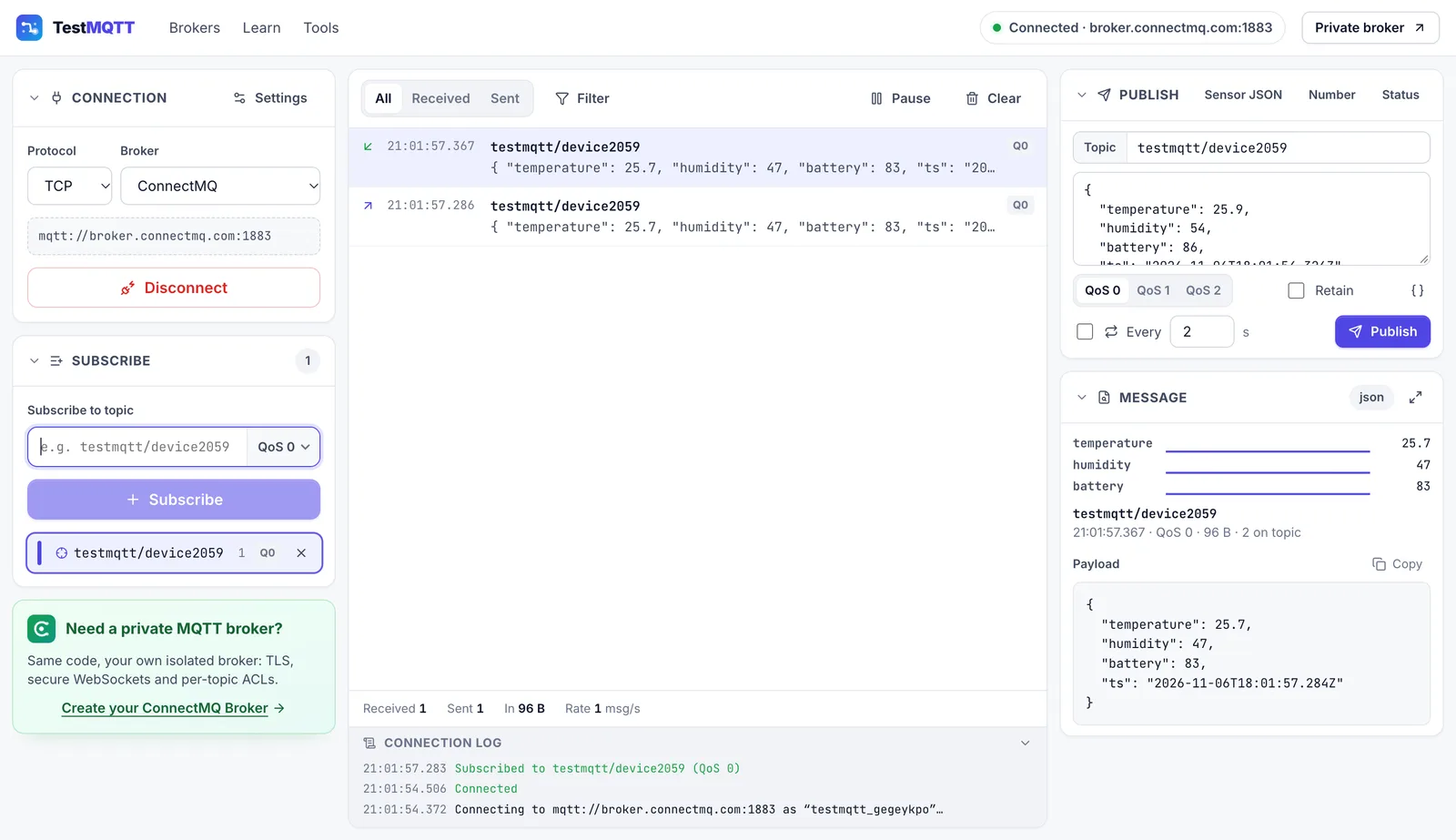
- Pick ConnectMQ, Localhost or your own broker and click Connect.
Why the desktop app?
Everything you know from the online client, without the limits of a browser.
Native TCP and TLS
Connects to mqtt:// and mqtts:// directly from your computer. No relay server, no WebSocket listener needed.
Local and private brokers
Reach brokers on localhost, in Docker or on your LAN (192.168.x.x) — impossible from a website.
Self-signed certificates
Switch certificate validation off for test brokers with self-signed or internal certificates.
Same familiar client
The interface of the online client: subscriptions, live message log, JSON viewer, QoS, retain and Last Will.
TestMQTT for other systems
Prefer not to install anything?
The online MQTT client runs in your browser and connects over WebSockets — and over TCP/TLS through our relay.
FAQ
Does TestMQTT run natively on Apple Silicon?
Yes. The Apple Silicon build runs natively on M1, M2, M3 and M4 Macs; the Intel build is for older Macs.
macOS says the app cannot be opened or verified. What now?
This release is not yet notarized by Apple. Open System Settings → Privacy & Security and click “Open Anyway” next to the TestMQTT message. If macOS says the app is “damaged”, you have an older download: get the current version from this page, or run xattr -cr /Applications/TestMQTT.app in Terminal.
Can I connect to Mosquitto running on my Mac?
Yes. Choose Localhost in the broker list: it connects to localhost:1883 (TCP) or 8883 (TLS) directly, no WebSocket listener needed.
Is TestMQTT free?
Yes. The desktop app and the online client are free to use, with no account or sign-up.
Which MQTT versions and protocols are supported?
MQTT 3.1.1 and MQTT 5 over TCP (mqtt://), TLS (mqtts://), WebSocket (ws://) and secure WebSocket (wss://).
Does the app store my broker password?
No. Passwords are only used for the current connection and are never saved. The app remembers non-secret settings such as keep-alive and MQTT version.